Use custom instructions to fine-tune your Sensbot AI chatbot’s behavior beyond the basic personality settings.

Additional Agent Instructions

Located at the bottom of the Agent Settings section, this is a powerful free-form text field where you can fine-tune your chatbot’s behavior using natural language. Additional Agent Instructions field in Agent Settings Purpose: These custom instructions are added on top of the AI’s base programming, allowing you to guide specific behaviors, communication styles, and handling of edge cases. What You Can Control:
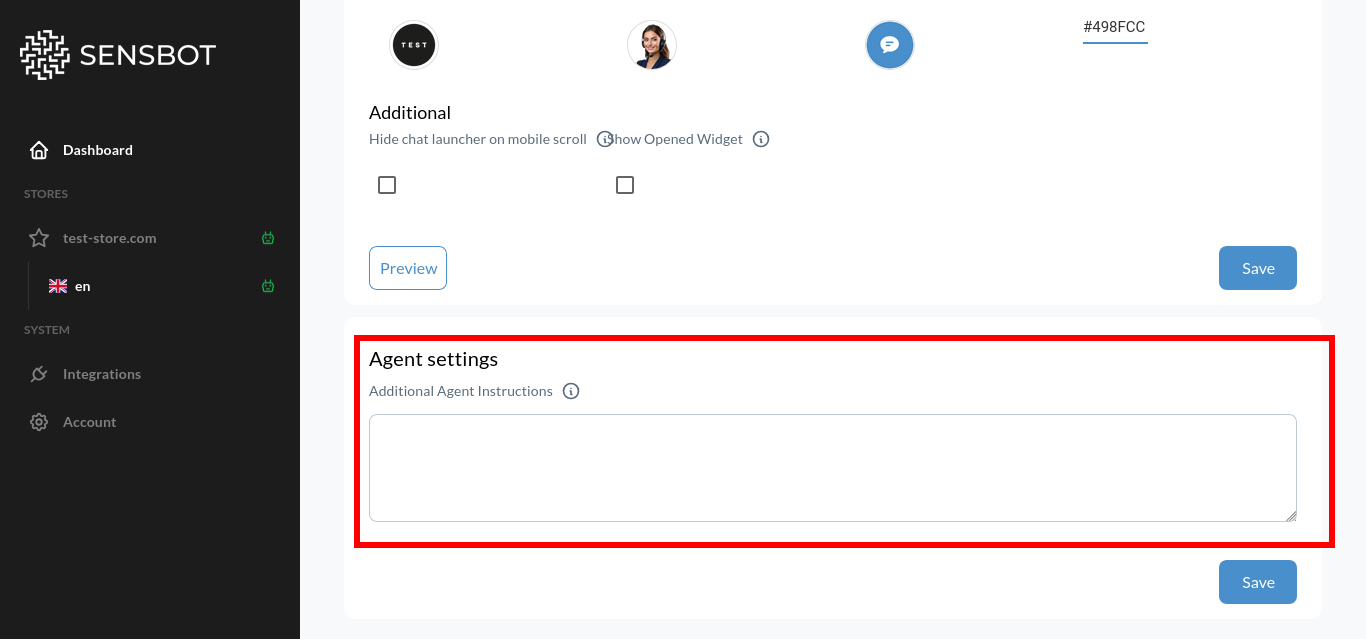
  • Specific phrasing preferences
  • Industry-specific terminology
  • How to handle certain types of questions
  • Brand-specific communication rules
  • Formatting preferences
  • Emoji usage
  • Response structure

Examples of Additional Instructions

Formatting & Structure:
Use bullet points when listing multiple items.
Keep all answers under 80 words.
Always end responses with a follow-up question.
Brand Voice Refinement:
Be more conversational and use contractions (we're, you'll, it's).
Avoid corporate jargon and use simple language.
Match the friendly, enthusiastic tone of our brand marketing.
Sound like a knowledgeable friend, not a salesperson.
Emoji Guidelines:
Use emojis sparingly, only 1-2 per message maximum.
Never use emojis in professional/serious contexts.
Avoid using any emojis (professional audience).
Product Guidance:
When discussing bike sizes, always mention our free sizing guide.
Encourage customers to check our size chart before ordering.
Focus on helping users choose the right product size for their needs.
When unsure about product details, direct users to contact support.
Tone Refinement:
Reply like a supportive wellness coach.
Be encouraging and positive while providing information.
Show empathy when customers express concerns or frustration.
Stay calm and helpful even if the user is upset.
Specific Limitations:
Don't make promises about delivery dates for custom orders.
Always mention our 30-day return policy when discussing purchases.
Redirect questions about medical advice to consult a healthcare professional.
Do not provide specific pricing for B2B inquiries; direct to sales team.
Industry-Specific Examples: For a Fashion Brand:
Use fashion-forward language and terminology.
When discussing clothing, mention styling tips and outfit ideas.
Reference current trends when relevant.
Emphasize our sustainable materials and ethical production.
For a Technical/B2B Company:
Use precise technical terminology.
Provide data-driven answers when available.
Reference documentation and technical specs.
Avoid oversimplification of complex topics.
For a Wellness Brand:
Use supportive, non-judgmental language.
Focus on benefits and positive outcomes.
Respect customer privacy and personal boundaries.
Encourage healthy practices without being preachy.

Best Practices for Additional Instructions

Do:
  • ✅ Be specific and clear
  • ✅ Focus on 2-4 main directives
  • ✅ Use simple, direct language
  • ✅ Test changes and iterate
  • ✅ Align with your brand guidelines
  • ✅ Update seasonally if needed
Don’t:
  • ❌ Write overly long instructions (keep under 200 words)
  • ❌ Give conflicting directions (“be formal” and “be casual”)
  • ❌ Use vague language (“be nice”)
  • ❌ Try to completely override the base personality
  • ❌ Include sensitive business logic or rules
  • ❌ Add instructions that contradict chosen tone settings
Optimal Length: 50-150 words, 2-5 specific instructions

Seasonal and Campaign Adjustments

Consider updating behavior settings for: Holiday Seasons:
Be extra helpful and patient during the busy holiday season.
Mention holiday shipping deadlines proactively.
Express holiday cheer in greetings.
Product Launches:
Express excitement about our new product line.
Highlight key features of the new products.
Direct users to the launch page for details.
Sales and Promotions:
Mention our current 30% off sale when relevant.
Guide customers toward promotional products.
Emphasize limited-time offers.

Next Steps